
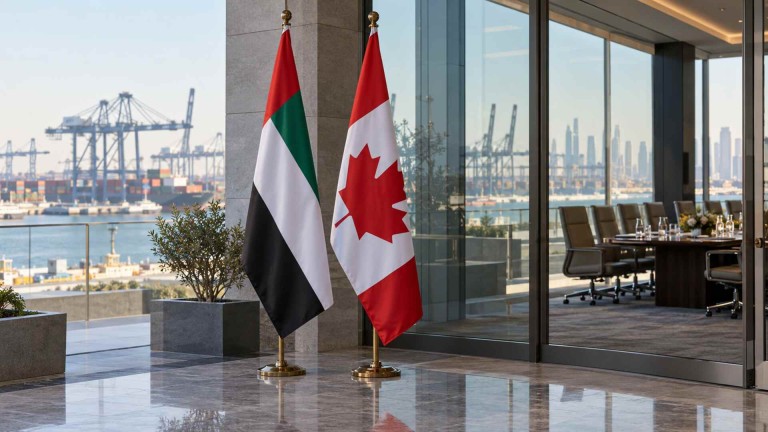
The United Arab Emirates and Canada have taken a significant step toward enhancing their bilateral relationship through a series of agreements focused on trade and defense. During a noteworthy visit by Abu Dhabi Crown Prince Sheikh Khaled bin Mohamed bin Zayed Al Nahyan to Ottawa, the two nations signed a Comprehensive Economic Partnership Agreement (CEPA), updated their defense cooperation agreement, and initiated discussions on diplomatic training. This move is aimed at expanding economic cooperation and strengthening long-term strategic ties between the countries.
The CEPA, which was negotiated in a remarkably short span of 47 days between November 2025 and July 2026, is set to reduce or eliminate tariffs on more than 99 percent of Canada’s current exports to the UAE. This agreement is anticipated to address existing trade barriers and broaden access to services, particularly in the engineering and environmental sectors. As Canada seeks to diversify its international economic partnerships, the agreement is expected to double bilateral trade over the next decade, reducing Canada’s reliance on the US market.
Canada’s existing economic ties with the UAE are already robust, with the UAE being the largest export market for Canada in the Middle East. Over 150 Canadian companies operate within the UAE, and the Emirates have committed up to $50 billion in investments in Canada. These investments focus on vital sectors such as energy, artificial intelligence, critical minerals, and infrastructure, complementing existing Canadian investments in the UAE’s chemical and logistics industries.
For the UAE, this partnership aligns with its broader strategy to expand international trade networks and diversify supply chains. Canada’s rich natural resources, agricultural output, and advanced engineering capabilities offer valuable opportunities for collaboration. The countries have identified several sectors with high potential for future cooperation, including critical minerals, food security, artificial intelligence, and infrastructure development.
To fully realize these agreements, further implementation steps are required. Canada’s Parliament must ratify the trade agreement, and investment commitments need to materialize into tangible projects. Despite the progress made, these initiatives reflect a mutual interest in economic diversification, secure supply chains, and enhanced international cooperation amid global trade uncertainties.