
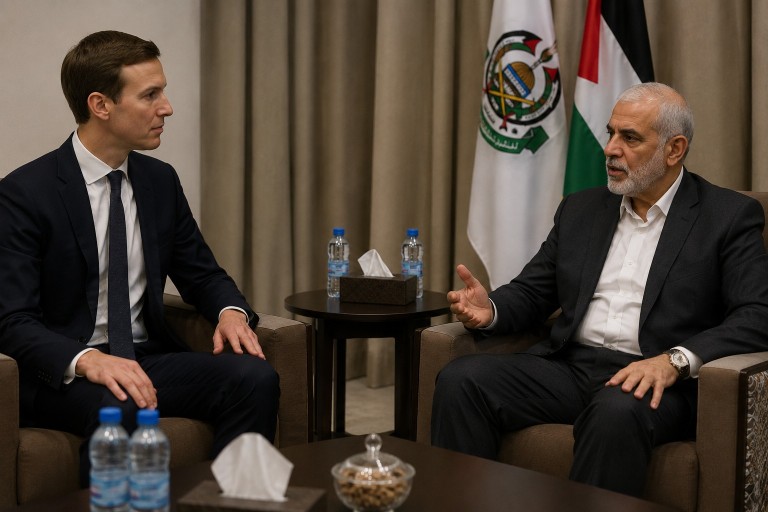
Jared Kushner, a key envoy and son-in-law to former U.S. President Donald Trump, engaged in diplomatic discussions with Khalil al-Hayya, the political leader of Hamas, during a meeting in Egypt on Sunday. This encounter is part of a renewed American initiative to breathe life into a faltering ceasefire plan for Gaza. Scheduled a day before Kushner’s talks with Israeli Prime Minister Benjamin Netanyahu, the meeting aimed to address stagnation in the ceasefire process after Netanyahu’s recent dismissal of a 15-point roadmap endorsed by the U.S. for the ceasefire’s next steps.
The proposed plan outlines a gradual disarmament of Hamas, coupled with a halt to Israeli military activities and a withdrawal from certain areas within Gaza. It further includes provisions for Gaza’s reconstruction and the deployment of international forces to enhance security measures. While Hamas has expressed its commitment to the roadmap, it demands that Israel cease attacks and retreat to a predefined “yellow line” before the plan’s implementation. Moreover, the group ties the relinquishment of its heavier weaponry to tangible progress towards establishing a Palestinian state, a concept Netanyahu’s government opposes.
Netanyahu maintains that a complete Israeli military withdrawal from Gaza is contingent upon the total disarmament of Hamas. This stance has led to a deadlock in key components of the ceasefire plan, such as reconstruction efforts and the introduction of international peacekeeping forces. Kushner’s discussions with Hamas, which included representatives from Egypt, Qatar, and Turkey, sought to secure Hamas’s agreement to the plan, specifically concerning disarmament, before his discussions with Netanyahu.
In addition to meeting Netanyahu, Kushner is set to engage with former British Prime Minister Tony Blair and Nickolay Mladenov, the director of the Board of Peace, to further diplomatic progress. Meanwhile, several regional nations, including Saudi Arabia, the United Arab Emirates, Jordan, Pakistan, and Indonesia, have voiced their disapproval of Israel’s rejection of the U.S.-backed roadmap, urging immediate steps to avoid further delays.
This revitalized diplomatic effort arises amid political challenges for Netanyahu, who is under pressure ahead of Israel’s upcoming October elections. His coalition comprises ministers advocating for a stricter stance on Gaza, casting uncertainty on the future of the ceasefire plan.