
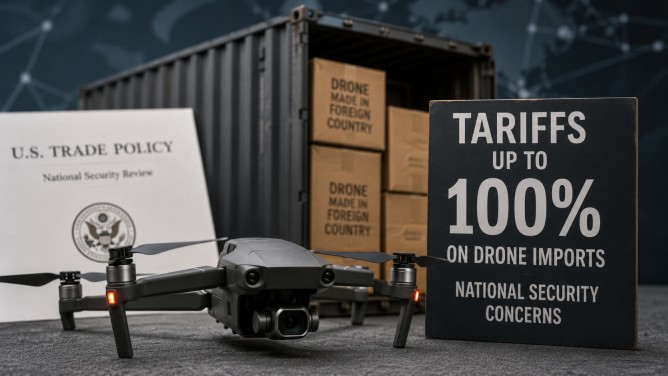
The United States is implementing substantial tariffs on specific drones and drone components, driven by national security concerns and the intention to lessen reliance on foreign supply chains, primarily influenced by China. This policy, targeting unmanned aircraft systems, will especially affect larger drones exceeding 25 kilograms and those with features related to national security, such as thermal cameras and docking stations. These products are set to incur a 100% tariff, while smaller drones will be taxed at a 25% rate.
Besides targeting Chinese imports, the US will apply tariffs on drones and components from various key trading partners. Goods originating from the European Union, Japan, Liechtenstein, South Korea, Switzerland, and Taiwan will face a 15% tariff, whereas imports from the United Kingdom will be subject to a 10% duty, assuming the hardware, software, and technology are produced in these countries or within the United States. The majority of these tariffs are scheduled to be enforced starting September 3.
The White House has articulated that these measures aim to bolster the US defense and industrial framework, stimulate domestic drone production, and generate jobs in the American market, thereby reducing dependence on foreign suppliers. Currently, China holds a dominant position in the global drone industry, with Shenzhen-based DJI commanding a significant portion of the US commercial drone market, which has already been under US scrutiny due to national security issues.
US authorities have raised concerns that drones manufactured abroad might pose risks related to surveillance, sensitive data gathering, and potential security breaches. In alignment with these concerns, the US Federal Communications Commission has advocated for increased domestic production to mitigate these risks. This development arises amidst ongoing trade and technology disputes between Washington and Beijing. Concurrently, China has implemented its own restrictions that impact drone exports to the US and has taken actions against several American firms.